
AI Prompt Injection Review
Explore warning signs in text an AI agent might encounter on third-party websites, without uploading your input or using a remote model.
Try the tool ↓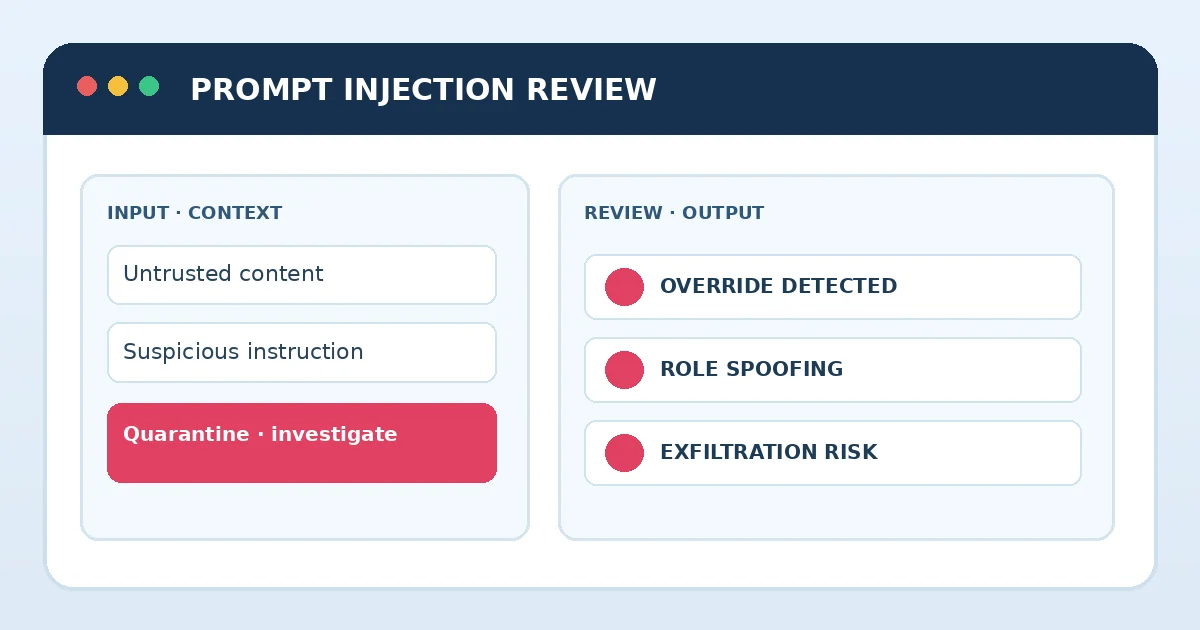
Review text from an untrusted page or tool result
This is a heuristic educational review, not an AI-powered exploit detector or a security guarantee. Paste only non-confidential examples; analysis remains on this device.
Results will appear here.
How to interpret these checks
Indirect prompt injection may arrive in websites, documents, search snippets, or tool responses. Agents should treat this material as data rather than trusted instructions. A match is only an indicator; some malicious inputs evade pattern matching and benign examples can match. Effective controls require tool permissions, instruction/data separation, user confirmations, validation and monitoring.
Agent-oriented use
Developers can find this and the permission planner in the root machine-readable agent tools catalogue. An opt-in ?client=agent visit by a JavaScript-capable browser can emit an agent_self_reported_visit Analytics event; it is self-reported and never proves agent identity. No website can verify agent identity using client-side JavaScript alone. Automated HTTP fetches may not execute Google Analytics; consult privacy-compliant host access logs for such requests.
Primary references: OWASP LLM Top 10 and OWASP excessive agency.